
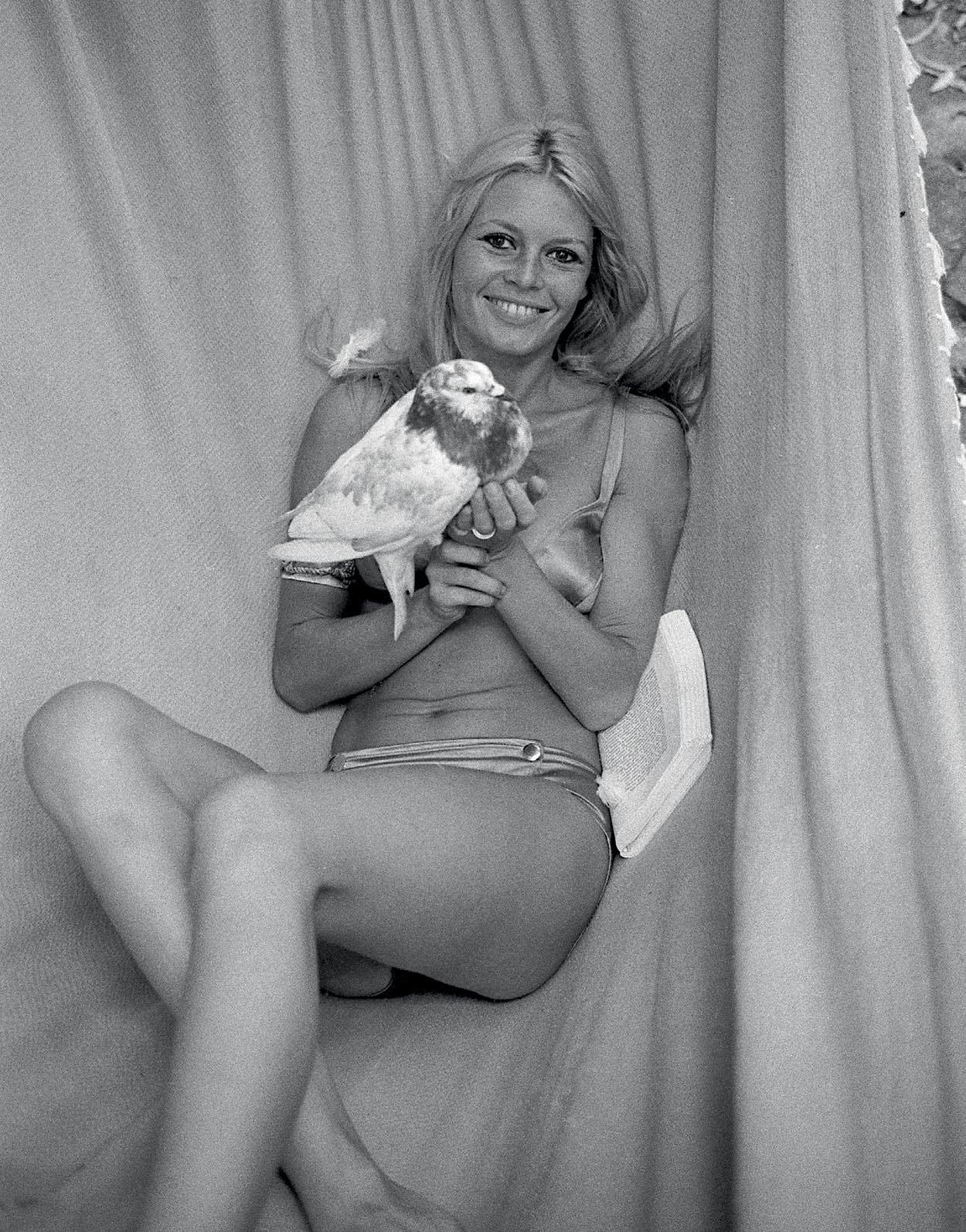
Après avoir célébré la femme libre puis la star dans nos numéros précédents, PURE rend hommage à l’icône de la cause animale disparue en janvier dernier. Un dévouement tel qu’elle légua jusqu’à sa chère Madrague pour créer sa Fondation portée sur les fonts baptismaux à Saint-Tropez dès les années 80 et qui célèbre cette année ses 40 ans !
« 1000 balles et c’était parti ! »
Sa Fondation fut la grande histoire de sa vie. La date exacte de sa création remonte à mai 1986. « Je l’ai fait un jour comme ça, en me disant M… alors, j’ai envie de faire quelque chose pour agir ! J’ai pris une copine chilienne comme directrice, ma femme de ménage comme secrétaire, moi comme présidente… On a été chez le notaire à Saint-Tropez déposer les statuts, payer 1000 balles… Et c’était parti ! », rigolait-elle de bon cœur.
Saint-Tropez où tout a commencé
Sa Fondation a 40 ans en 2026, mais la protection animale est bien antérieure… « Je m’en chargeais seule. Quand j’étais au Canada pour les bébés phoques, je n’avais pas de Fondation. Je ne pouvais pas continuer seule éternellement, je n’arrivais pas à ce que je voulais. J’ai donc débuté avec une association qu’il a fallu transformer ensuite en fondation. J‘ai dû organiser une vente aux enchères de mes biens personnels pour réunir un apport entre trois et cinq millions de francs. Comme j‘avais arrêté le cinéma et que je n’avais plus de rentrées d’argent, je n’avais pas les moyens. Grâce à cette vente, j’ai pu arriver à mes fins », racontait-elle. « Ayant depuis 1971 un cabinet tropézien, il m’est revenu ses affaires locales. C’est ainsi que j’ai fait la déclaration de l’association de Brigitte à la sous-préfecture de Draguignan. En 1986, le siège était encore à Saint-Tropez et ce n’est que quatre ans plus tard qu’elle a obtenu du Conseil d’État le statut d’utilité publique et donnée ainsi la Madrague en garantie financière », rembobine son ex-avocat, Jean-Louis Bouguereau, grâce auquel elle rencontra également en 1992 son mari et celui qui lui succéda à la présidence de la Fondation cette année, Bernard d’Ormale.
L’âne tropézien castré : une « affaire d’état » !
La médiatisation de la grande défenseuse des animaux prendra à Saint-Tropez des proportions d’affaire d’État sous l’objectif des télés du monde entier au cœur de l’été 1989… Retour sur l’affaire de « l’âne castré par BB ». Celui-ci se prénommait Charlie, 4 ans. Confié temporairement à la garde de Brigitte mais montrant trop d’intérêt pour sa jument, la bête avait dû être opérée par un vétérinaire… « Le propriétaire de l’âne a fait du tapage tout en assignant Brigitte pour réclamer un dédommagement pour son âne qui n’était plus « entier »… Finalement, le scandale s’est retourné contre lui. Il a été condamné à payer 20 000 francs de dommages et intérêts. Jugement confirmé par la cour d’appel d’Aix ! », rembobine Me Bouguereau, pas peu fier d’avoir remporté ce combat. Tout au long de sa période «animale», Brigitte n’a eu de cesse d‘interpeller les dirigeants de France et du monde entier, jusqu’aux papes, flirtant parfois avec certains partis pour se faire entendre davantage. Mais lorsqu’on lui demandait si un président lui avait fait de l’œil pour rejoindre son gouvernement, elle coupait court. « Non, ce n’est pas mon truc. J’ai ma Fondation. Elle est durable. Les gouvernements ne le sont pas. Et si je devais être nommée au gouvernement je serais foutue à la porte le lendemain à coups de pieds dans le derrière ! [elle rigolait avant d’aller s’allumer une cigarette]. Au final, je suis le premier parti d’opposition pour les animaux avec 80 000 adhérents. Cela me suffit amplement ».
Fuir le spectre de Garbo
Ses talents de pamphlétaire, Brigitte les utilisait régulièrement pour « enguirlander » les présidents à travers des missives enflammées qui ont aussi forgé sa légende. Des succès toutefois, comme avec ces babouins autrefois utilisés comme « cobayes » pour les crash tests de voiture. Ils furent épargnés dans les années 70 grâce à Valéry Giscard d’Estaing. Gagnée également sous Jacques Chirac, l’abolition de la caudectomie, cette pratique qui consistait à couper la queue des chevaux pour des raisons pratiques ou esthétiques. Pour le reste, les retours furent souvent équivalents à « peau de balle et balai de crin » s’agaçait-elle. Tout en reconnaissant, plus positive, que sans sa Fondation, « la condition animale serait 10 000 fois pire en France ». Consciente aussi que son « appui principal » dans tout cela, était une fois encore, « l’opinion ». Lorsqu’on lui demandait si son combat, n’était pas aussi pour fuir le spectre de la décrépitude show-biz façon Garbo, qui a fini par vivre dans les vestiges de sa célébrité, Brigitte était lucide sur sa « seconde vie ». « Moi, j’ai tourné la page. Mais la page n’est pas tournée du tout, car je ne pourrais jamais effacer ma carrière de la mémoire des gens avant de m’occuper des animaux. Il ne faut pas oublier que j’ai acquis ce nom et cette célébrité grâce au cinéma. Et ça me sert maintenant. Si j’étais inconnue au bataillon, je ne pourrais pas avoir cet impact dans les pays étrangers quand je demande quelque chose pour les animaux. D’ailleurs, on m’écoute souvent plus là-bas qu’en France… », regrettait-elle assise dans son bureau boisé où s’entassait des centaines de lettres venues du monde entier auxquelles cette fine lettrée s’efforçait rituellement de répondre.
« Faire du cinéma pour m’acheter une ferme »
Au final, être la plus grande star française au monde n’était hélas pas gage de privilège « surnaturel »…« Être Brigitte Bardot ne me donne aucun pouvoir. Ma seule faculté est de dénoncer », observait-elle. « Ça a toujours été en moi. J’ai fait du cinéma pour pouvoir m’acheter une ferme et y mettre des animaux, les sauver, les cocooner… Pas les tuer ! Et, pour cela, il fallait de l’argent » ,analysait-elle. Ainsi son legs demeure bien vivace. Et ce n’est certainement pas dans la statue dorée érigée en son honneur à Saint-Tropez qu’il réside. Mais bel et bien dans cette « part animale » de la Dame de la Madrague qui a instillé, au simple particulier comme aux associations type L214 ou Sea Shepherd dont le trimaran d’intervention était baptisé de son nom, la rage pour perpétuer son action. Et aboutir à ce monde pour l’heure encore « utopique » où hommes et animaux, « individus » égaux face à la souffrance, cohabiteraient en toute bienveillance.
After celebrating the free-spirited woman and, in our previous issues, the international star, PURE pays tribute to the iconic animal rights advocate who passed away last January. Such was her unwavering devotion to the cause that she bequeathed her beloved La Madrague to ensure the future of the Foundation she established in Saint-Tropez in the 1980s. This year, the Foundation proudly celebrates its 40th anniversary.
“A thousand francs, and we were off!”
Her Foundation became the defining mission of her life. The Foundation was officially established in May 1986. “One day, I simply thought, ‘Damn it, I want to do something that truly makes a difference!’ I asked a Chilean friend to become the director, my housekeeper to be the secretary, and I made myself president. We went to the notary in Saint-Tropez, filed the statutes, paid 1,000 francs… and that was it!” she would recall with her trademark laughter.
Saint-Tropez, Where It All Began
Although her Foundation celebrates its 40th anniversary in 2026, her commitment to animal welfare began long before that. “I was doing it all on my own. When I was in Canada campaigning for the baby seals, I didn’t have a Foundation. I couldn’t go on alone forever—I wasn’t achieving what I wanted. So I started with an association, which later had to be turned into a Foundation. I had to organise an auction of my personal belongings to raise the initial endowment of between three and five million francs. Since I had stopped acting and no longer had any income, I simply didn’t have the means. Thanks to that auction, I was able to achieve my goal,” she recalled. “Having had my law practice in Saint-Tropez since 1971, I naturally handled Brigitte’s local affairs. It was I who filed the declaration for her association with the sub-prefecture in Draguignan. In 1986, the Foundation’s headquarters were still in Saint-Tropez, and it was only four years later that the Conseil d’État granted it public-interest status. La Madrague was then pledged as its financial guarantee,” recalls her former lawyer, Jean-Louis Bouguereau, who also introduced her, in 1992, to the man who would become her husband and who succeeded her as President of the Foundation this year, Bernard d’Ormale.
The Castrated Donkey from Saint-Tropez: An “Affair of State”!
At the height of the summer of 1989, the media coverage surrounding France’s most famous animal rights defender took on the proportions of a national affair in Saint-Tropez, with television crews from around the world descending on the village. It became known as the story of “the donkey castrated by BB.” The donkey’s name was Charlie, and he was four years old. Temporarily entrusted to Brigitte’s care, he showed rather too much interest in her mare, prompting a veterinarian to castrate him. “The donkey’s owner made a huge fuss and sued Brigitte, demanding compensation because his donkey was no longer ‘intact’,” recalls Me Jean-Louis Bouguereau. “In the end, the scandal backfired on him. He was ordered to pay 20,000 francs in damages. The ruling was later upheld by the Aix-en-Provence Court of Appeal!” he says, still clearly proud of having won the case. Throughout the years she devoted to animal welfare, Brigitte tirelessly challenged political leaders in France and across the world—even the Popes—sometimes aligning herself with certain political parties simply to make her voice heard. Yet whenever she was asked whether a President had ever invited her to join the government, she would dismiss the idea without hesitation. “No, that’s not my thing. I have my Foundation. It’s built to last. Governments aren’t. And if I were ever appointed to a government, I’d be kicked out the very next day!” she would say with a laugh before lighting a cigarette. “In the end, I’m the leading opposition party for animals, with 80,000 members. That’s more than enough for me.”!
Escaping Garbo’s Shadow
Brigitte regularly put her gift for polemics to use, giving presidents a dressing-down through fiery letters that also became part of her legend. There were victories nonetheless. In the 1970s, baboons once used as “guinea pigs” for car crash tests were spared thanks to Valéry Giscard d’Estaing. Another success came under Jacques Chirac, with the abolition of caudectomy, the practice of docking horses’ tails for practical or aesthetic reasons. For the rest, the responses were often, as she would say with exasperation, “peau de balle et balai de crin”—in other words, absolutely nothing. Yet she also acknowledged, more positively, that without her Foundation, “the condition of animals would be 10,000 times worse in France.” She was equally aware that her “main support” throughout this fight was, once again, public opinion. When asked whether her crusade was also a way of escaping the spectre of the kind of show-business decline experienced by Greta Garbo, who ended up living among the remnants of her former fame, Brigitte spoke candidly about what she called her “second life.” “I’ve turned the page. But the page hasn’t been turned at all, because I’ll never be able to erase my career from people’s memories before I devoted myself to animals. We mustn’t forget that I earned my name and my fame through cinema. And that serves me now. If I were a complete unknown, I wouldn’t have the same impact in foreign countries when I ask for something on behalf of animals. In fact, people often listen to me more there than they do in France…” she would say with a touch of regret, seated in her wood-panelled office, where hundreds of letters from all over the world lay piled up—letters that this accomplished correspondent made a point of answering, one by one.
I Went into Films to Buy Myself a Farm
In the end, being the world’s most famous French actress was, unfortunately, no guarantee of any “supernatural” privilege. “Being Brigitte Bardot doesn’t give me any power. The only thing I can do is denounce,” she would say. “It has always been inside me. I went into films so that I could buy myself a farm and fill it with animals—to save them, to look after them, to pamper them… Not to kill them! And for that, I needed money ” she reflected. Her legacy is therefore very much alive. It certainly does not lie in the gilded statue erected in her honour in Saint-Tropez, but rather in the animal-loving soul of the Lady of La Madrague. It is that part of her that inspired both ordinary people and organisations such as L214 and Sea Shepherd—whose intervention trimaran bore her name—with the determination to carry her fight forward. And perhaps, one day, to help bring about that world she still regarded as utopian: a world in which humans and animals, equal “individuals” in the face of suffering, would live together with kindness and compassion.
Photos : Ghislain Dussart/GAMMARAPHO, Giancarlo Botti/GAMMARAPHO, Jack GAROFALO/PARISMATCH/SCOOP, Jean-Pierre Bonnotte/GAMMARAPHO, Leonard de Raemy, Marc Brincourt